
MAIN FEATURES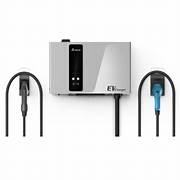
Level 2 Wallbox DC Charger
Current: Max 25 kW
Output: SAE J1772 CCS / CHAdeMO (option dual ports)
Operating temperature: -22°F to +122°F (-30°C to +50°C)
START CHARGING
- Plug and Charge. Connect the plug to the EV.
- Swipe the authorized RFID card to start charging. Charging session will start.
- Once charging commences, status information is displayed on the screen (kWh, time and percentage of charge)
START CHARGING
- Swipe the authorized RFID card to stop.
- Return the plug to the holder.

In some cases, the EV locks the connector. To unlock the connector, obey the instructions for the EV. It may be necessary to unlock all doors of the EV, or use the ‘unlock charge connector button’ on the car key, if present.
 STOP
STOP
Charging will stop without user interaction:
• In case of alarm/hazard.• When the battery is full, the charge session stops automatically.
• When the maximum charge time set by the operator/owner has been reached.
IF THERE IS AN EMERGENCY
- Push the emergency stop button at the back of the charger enclosure. The charger stops all ongoing charging sessions and shows red light in the front push buttons.
- Contact the Site Manager/Operator.
EMERGENCY
Only push the emergency stop button if there is an emergency!
Further recommended reading:
DO YOU HAVE AN ISSUE THAT REQUIRES FURTHER ASSISTANCE?
Please, do not hesitate to contact us trough:
- 7Gen Customer Support Portal. By clicking here you can find instructions on how to create an account within our support center.
- Email: support@7gen.com
- Call: +1 855 743 6938 (+1-855-7GENZEV)
NETWORK CONNECTIVITY AND ACCESS CONTROL
The Delta DC Wallbox uses OCPP 1.6J as its communication interface between the charging device and your charging management system. The charger connects via Ethernet, enabling remote monitoring of sessions, energy consumption reporting, and payment processing without requiring on-site intervention. This smart network connectivity allows site operators to view real-time charging status, configure session limits, and receive alerts through a compatible backend platform.
For function access control, the built-in RFID card reader ensures only authorized users can initiate a charging session. When an authorized RFID card is presented, the EV charging station validates the credential before releasing power to the vehicle connectors. Operators can manage authorized RFID credentials remotely through their network-connected backend, making it straightforward to add or revoke access across a fleet or commercial site without visiting each charge point individually.
CHARGER PROTECTION AND SPECIFICATIONS
The Delta DC Wallbox is built for outdoor and semi-exposed commercial installations. Its enclosure carries an IP55 weatherproof rating, protecting internal components against dust ingress and low-pressure water in any direction. For physical security, the charger meets IK08 impact resistance standards for display mechanical impact strength, meaning the housing can withstand significant force, which is important in high-traffic public or commercial environments.
Internal power management includes overcurrent protection, surge protection, and ground fault detection to safeguard both the EV charging device and the connected vehicle. The unit delivers up to 25 kW at up to 94% efficiency and operates across the temperature range already noted in the main features, making it suitable for year-round performance in variable Canadian conditions. The relevant conformity Delta Electronics maintains for this EV charging device covers applicable international safety and electromagnetic standards for electric vehicle charging equipment and products.
COMMERCIAL AND FLEET APPLICATIONS
The Delta DC Wallbox is well suited to commercial EV charging environments including fleet depots, workplace parking, retail locations, and public charging areas. With two output connector options, CCS and CHAdeMO, a single ev charging station can serve a wider range of electric vehicle makes and models without additional infrastructure. This dual-connector design is particularly valuable for fleet operators managing mixed-vehicle fleets where different vehicles use different connector standards.
Sites requiring simultaneous DC charging for multiple vehicles should deploy additional units, with OCPP-based load management coordinating power distribution across all chargers sharing the same electrical supply. This kind of power management helps avoid demand spikes and keeps operating costs predictable, which is a key consideration for business and fleet charging deployments. The wall-mounted design keeps the footprint compact, and easy access to the cable and plug holder supports high-turnover charging in commercial and public locations.
DC CHARGING AND BATTERY MANAGEMENT
DC charging delivers power directly to the battery, bypassing the vehicle's onboard AC converter and enabling faster charging compared to standard AC equipment. As with all DC charging technology, charging speed naturally decreases once the battery reaches approximately 80% capacity. This is a normal function of lithium-ion battery management systems, which reduce the incoming charge rate to protect long-term battery health and prevent overheating.
For everyday fleet operations, unplugging at 80% is generally sufficient for most routes and saves time at the charging station, as the final 20% takes proportionally longer to complete. Continuing to 100% is appropriate when maximum range is needed for a longer trip. EV drivers and fleet managers can monitor charge progress using the percentage of charge displayed on the charger screen during an active session.
CHARGING STATUS AND INDICATORS
The Delta DC Wallbox includes front-panel indicator lights that give EV drivers and site operators immediate visual feedback about the current state of the EV charging device. The charging status light on the front of the unit changes to reflect standby, active DC charging, session complete, or a fault condition requiring operator attention.
Drivers should only touch the designated push buttons and RFID card reader on the front panel. During an active session, indicative charging times will vary depending on the vehicle's battery capacity and initial state of charge. A session can be cancelled at any time by swiping the authorized RFID card to stop. Once stopped, the plug should be returned to the holder to keep the cable secured and the charge point ready for the next user. If the charging status light shows an unexpected state, check the display for more information and contact your site manager if the issue persists.
DELTA ELECTRONICS EV SOLUTIONS AND RESOURCES
The Delta DC Wallbox EV charger is part of a wider range of electric vehicle solutions provided by Delta Electronics, covering AC and DC charging products suitable for different power requirements and site configurations. This wallbox EV charger is sourced and deployed by 7Gen as part of a commercial EV charging infrastructure program, and is one of several Delta Electronics products available for fleet, business, and public charging deployments.
For a complete overview of the electric vehicle solutions selection available through 7Gen, contact your account representative. They can confirm which products are in stock and suited to your site requirements. The manufacturer's manual provided with this unit is also available to download through the link in the Further Recommended Reading section above. The manual contains technical specifications, installation requirements, product images and technical drawings, and conformity documentation for Delta Electronics' electric vehicle charging equipment. Operators who need to review the full electric vehicle solutions manuals for their deployed equipment can access these through the 7Gen Customer Support Portal.